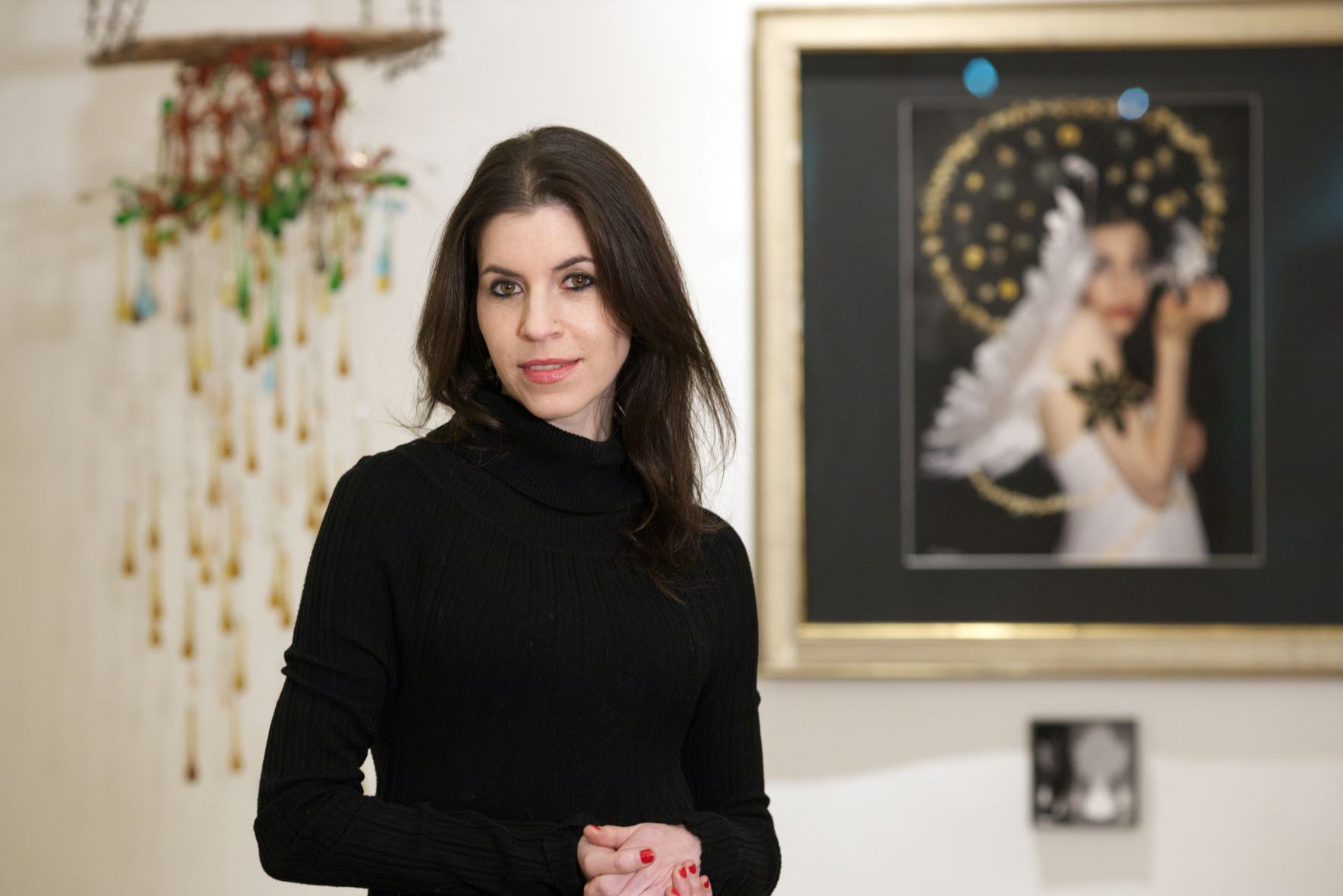


Let Me Back Into Your Garden of Eve
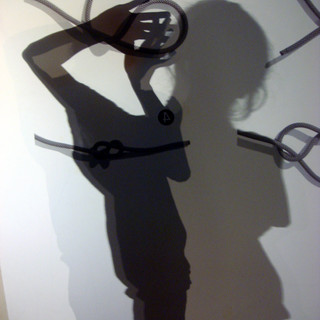
– where lace, shadows and memory become one. At FUGA - Contemporary Architecture Center till August 30.

I am delighted to share that my new solo exhibition Let Me Back Into Your Garden of Eve - From Natural Pattern to Synthetic Code, curated by Mihály Surányi has successfully opened at FUGA – Contemporary Architecture Center in Budapest.
The exhibition was - after the opening words of Anžej Frangež, the Ambassador of Slovenia to Hungary - inaugurated with an insightful opening address by Dr. Szilvia Csanádi, art historian and critic, and will remain on view through 30 August 2026.
With Szilvia Csanady
Installed across two interconnected underground gallery spaces—once a bank vault and, before that, an air-raid shelter during the Second World War—the exhibition invites visitors into a layered environment where history, memory, biology and technology intersect.
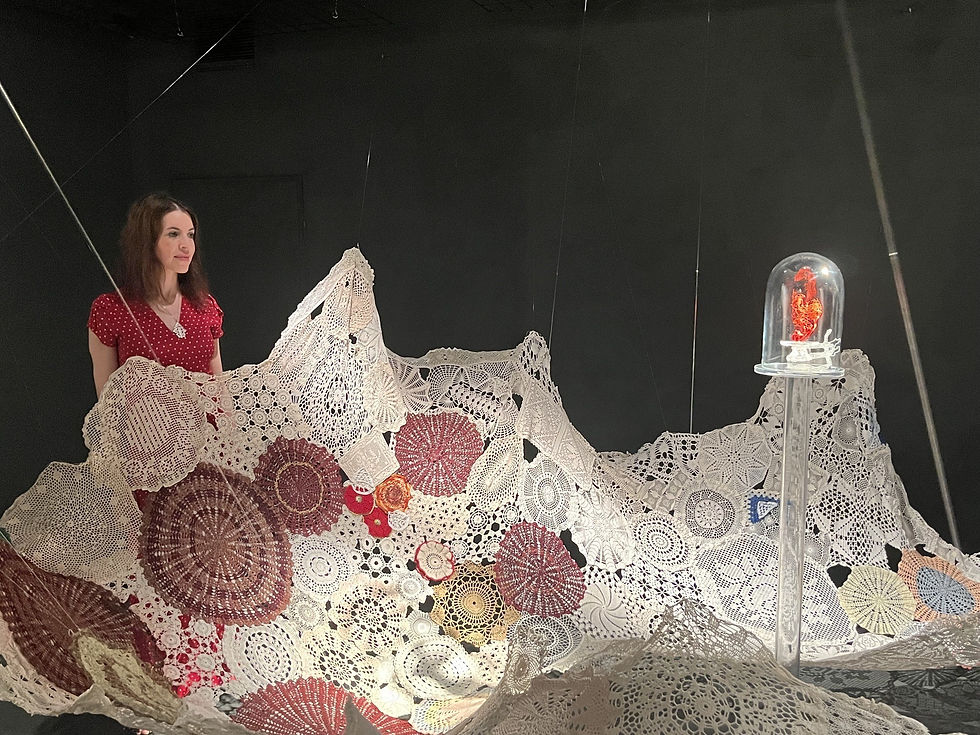
More than a presentation of objects, the exhibition unfolds as a dialogue between material forms and their immaterial counterparts. The engraved plexiglass figures and monumental recycled lace assemblages are completed by their shadows, which become equal participants in the work. Together, object and shadow create a shifting landscape that changes with the movement of light and the viewer.

What are the thresholds—points at which a line can still bend but does not break, the moments when technology can transform life without emptying it of meaning? The video, sound and text of Bending Point / Breaking Point articulate this tension: fear of disintegration, longing for belonging, and the question of who bears the consequences of our interventions.
Furthermore, it introduces the experience of a body at its limit—a body subjected to pressure, filtration, transformation, and fragmentation. The notions of the “bending point” and the “breaking point” form the conceptual axis of the exhibition, asking where the threshold lies between transformation and irreversible rupture.
Projected through one lace assemblage onto the floor is a satellite image of Lake Balaton. Through another, only the shadow remains, revealing an empty silhouette—as if the lake itself had disappeared. This visual absence enters into dialogue with the video Holes in Light, gently raising questions about environmental change, memory and what may quietly vanish before we fully notice.
As suggested in the exhibition text:
What does it mean to be human today—or more precisely, what does it mean to be an Earthling?

Throughout the exhibition, recycled handmade lace, analogue photography, hand-engraved plexiglass, sculpture, video and sound invite visitors to reflect on one of the defining questions of our time:
What happens when nature's patterns become technological codes?
One of the exhibition's central works is Incubator E@motion, presented for the first time and marking the beginning of my ongoing collaboration with the Department of Anatomy and Cell Biology at the Medical University of Vienna (AKH Vienna). At its centre is a formalin-preserved human heart entrusted to me for educational purposes, becoming within the exhibition a reflection on vulnerability, empathy, continuity and care.
In the exhibition title, Eve refers to the original body and biological script that contemporary technologies are reopening and reshaping. Eve is not presented as an idealized myth, but as a vulnerable and mutable living system.
My heartfelt thanks go to FUGA Director Kristóf Asbóth, curator Mihály Surányi, Dr. Szilvia Csanádi, the entire FUGA team, the Department of Anatomy and Cell Biology at the Medical University of Vienna, and the Ministry of Foreign and European Affairs of the Republic of Slovenia for making this exhibition possible.

My work does not oppose technology; it cautions against forgetting. Like Ariadne’s thread in the labyrinth of contemporary systems, I seek to preserve traces of human vulnerability, doubt, and responsibility. For if we gaze too long into the abyss of our own creations, the abyss may begin to gaze back—altered. Rather than offering definitive answers, the exhibition opens a reflective space: can technological imitation of nature preserve vulnerability, imperfection, and ethical awareness—qualities intrinsic to human existence?
In the adjoining space, engraved plexiglass plates present human silhouettes abstracted into lace-like patterns. Here, the body is reduced to a trace, a pattern, a data-like imprint. The human figure emerges as a hybrid entity—assembled, recycled, and fragmented—an Earthling increasingly distanced from its origins.
The engraved plexiglass figures originate from photographs of my own shadow, translated into lace-like structures. In this way, something immaterial becomes material again—the shadow transformed into an Earthling.

I warmly invite everyone visiting Budapest this summer to experience the exhibition.
Copyright © Eva Petrič, 2026,Bildrecht Vienna, All rights reserved.


